Distributism
Why this notion, which is at odds with the left and the right, might be a path going forward

I recall some discussions on the trading desk back in the mid 2010’s where I laid out a theory that we were going to return to the Middle Ages. The Tech Titans would be the kings, those that worked in Big Tech would be the knights, and the rest of us would be serfs because the former two groups would own all of the assets.
That theory was in fact pretty dystopian, but there are elements of it that are not so far off. In doing some more digging, what we may be going through in this AI arms race could look much more like the Industrial Revolution, though. That in and of itself could radically define the next several decades.
Flashback
At the end of the 19th/early 20th century, the world was dominated by the Robber Barons/Industrial Giants (depending on your perspective) and those that financed them. Rockefeller, Carnegie, Mellon, JP Morgan and Leverhulme among others. They amassed amazing wealth, the likes of which we probably still haven’t seen yet, and found many opponents to their success because many were left behind even though they did not understand what a GINI coefficient is.
In fact, capitalism was so hated, it spawned the complete opposite view with those that espoused socialism. Sure, there was Marxists and Communists but even among the elites, there was an idea that maybe that was too extreme, but we needed to combat rampant capitalism.
The Fabian Society is one of the most influential political think tanks in modern history. Founded in London in 1884, it laid the intellectual groundwork for the modern British welfare state and helped establish the British Labour Party.
Unlike Karl Marx, who believed capitalism could only be overthrown through a violent revolution by the working class, the Fabians believed socialism should be brought about gradually, peacefully, and from the top down through legislation, bureaucratic planning, and policy reform.
Famed writers such as George Bernard Shaw and HG Wells were proud and vocal members of The Fabian Society. The name comes from the Roman general Fabius who defeated Hannibal. Their motto was homage to the strategy he used to defeat him which looks a lot like guerilla warfare: “For the right moment you must wait... but when the time comes you must strike hard, as Fabius did, or your waiting will be in vain and fruitless.”
These are the theories we learn about most in university: conservatives and progressives, those that favor free markets and those that favor government control, those that think corporations are the path to success and well-being and those that think government ownership or control is the path to success and well-being.
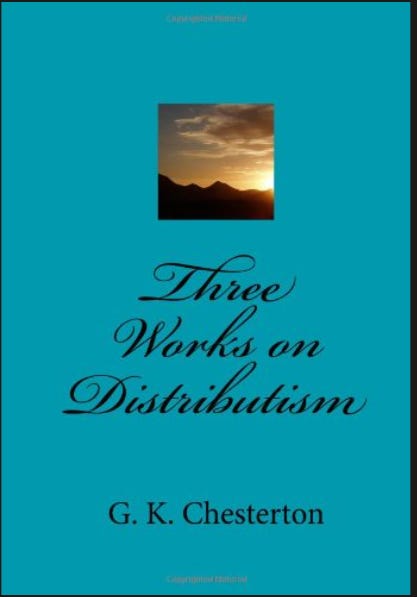
However, those were not the only two camps in the debate. GB Shaw’s best friend was a man named GK Chesterton, who fiercely opposed both Monopoly Capitalism and State Socialism. Chesterton’s peer in this camp was Hilaire Belloc and together they formed a theory called Distributism - drawing from Pope Leo XIII’s landmark 1891 encyclical Rerum Novarum - as they were both Christian men.
They were responding to what they saw as two sides of the same coin: Monopoly Capitalism (which concentrates property in the hands of a few tycoons) and State Socialism (which concentrates property in the hands of the state). Their solution was widespread, local ownership of productive property: “Too much capitalism does not mean too many capitalists, but too few capitalists.”
They were not against the local farmer or baker earning a fare wage for the business he owned. They were against what they saw as inevitable - either a few tycoons ultimately owning everything or the state ultimately owning everything. Chesterton called them feudal lords in business suits. This starts to sound like what I was saying in 2015.
Fast Forward
I wrote a LinkedIn post today based on a story I read overnight about the Chinese government looking to support their stock market which has been in freefall. One thing I said was “Nothing may identify the technology/AI arms race, some might say the 2nd Cold War, better than headlines about a Communist government supporting the stock market.”
After writing the post I spent some time on LinkedIn and came across this post from Raoul Pal of Global Macro Investor:
https://www.linkedin.com/pulse/economic-singularity-raoul-pal-gldpf/
We have all heard of the 4th Industrial Revolution, originated by Klaus Schwab of the World Economic Forum and the 4th Turning by Neil Howe and William Strauss. the former discusses how technology (AI, automation, biotech and quantum computing) and the exponential adoption of it impact how humans work. The latter discusses how changing generational attitudes rebuild society’s institutions. Both are focused on the disruption to society that is upon us.
Raoul brings many of these concepts together in his piece in what he calls The Economic Singularity. He summarizes it quite well and while he does view everything through the lens of crypto (I am not saying he is wrong), he lays out some very interesting points:
1. GDP Growth = Population Growth + Productivity Growth + Debt Growth
If “population growth” can be infinite because of building AI-powered robots, is GDP potentially infinite? What does that mean for consumers, who would presumably be without jobs?
2. GDP as a measure of success, then
As Raoul says, “Start with GDP, the number the whole world steers by. GDP counts production, because for all of history production was the hard part. A few percent of growth mattered because a few percent was all you could ever squeeze out. Now bolt that gauge onto an economy that can double in a year. WTF is it measuring? I wrote back in 2024 that beyond 2030, GDP may stop being a useful measure of anything for humanity, and I meant it literally.”
3. Universal Basic Income
The solution as put forth by many in the tech industry and even those in politics is for the machines to be taxed and humans be given some stipend. However, as he points out, this makes humans dependent on the robots and on the government to collect. As I laid out in my theory back in 2015, we would become the serfs for the kings and knights.
4. Universal Basic Equity
It is interesting he lands here because ironically, in some ways, both Donald Trump and Bernie Sanders are landing here too. They say the government should own a stake in all of these AI companies. These stakes should be given to the citizens. I doubt they agree on how that should happen, but it comes down to the idea that the government is owning companies. This starts to sound like government owning the means of production. This starts to sound like the debate between the Robber Barons and the Fabian Society.
We know there are those in Silicon Valley who will argue the same arguments made by the Industrialists in the early 20th Century. Leverhulme (founder of Lever Brothers which became Unilever) was generous in building entire towns for his workers, as long as they followed his strict rules. Rockefeller talked about a form of social Darwinism. Carnegie felt that wealth concentration in the hands of the few was inevitable and beneficial. Do you think Musk, Thiel, Bezos, Karp and Altman hold dramatically different views?
Democratic Socialists don’t want to break up the tech ‘monopolies’ because it just creates mini-monopolies. They don’t see AI and tech as inherently evil. They see the incentive structure of capitalism as evil. They prefer state ownership to prevent this incentive structure.
With affordability and jobs on the docket this November, are we going to see the Silicon Valley bros vs. the Democratic Socialists?
A Third Way
Much like Chesterton and Belloc posited and argued for a third way, a path that did not look like Monopoly Capitalism or State Socialism, we may be some arguing for this now.
I came across what I thought was a fascinating interview by Bishop Barron of Vice President JD Vance. I am a big fan of anything Bishop Barron puts out, not just because I agree with him, but because I find him to be one of the top intellectuals of our day. Listen to his debates, discussions and interviews. Watch the speech he gave at America’s 250th birthday. Suffice to say, the algo’s populate my feed with his content.
I did not know what to expect of the interview when I saw it. JD Vance has become a figure that is somewhat vilified on both the left and the right. The left sees him as Trump’s attack dog, lacking civility, and embodying the same brutal message. The right sees many of his comments, particularly where he said that maybe we need to move beyond the views of Milton Friedman, as an abandonment of core conservative ideology.
I encourage you to listen whether you like him or not. You will surely learn something. That is important since he is likely leading the ticket in 2028. You might want to know what you are (or aren’t) voting for.
One of the things he said that stuck with me is that maybe we need to move beyond GDP as the measure of everything. This was interesting because I just read Raoul who said GDP may even become useless as a measure of anything.
He gives examples such as: When a woman gives birth, if we measure utility through economic means only, she should go back to work the next day. Of course, this is ridiculous (his wife just did give birth) so there must be a way that measures societal benefits beyond economics. Another example, maybe even more near and dear to his heart is globalization. The economic decision was very clear and followed by capitalists and politicians alike. It was cheaper to make goods overseas. This brought cheaper goods for consumers. It was seen as a win. That is, only in short-term economic gains. It missed the entire disruption to populations particularly in the Rust Belt. It was, to paraphrase Ross Perot, the “giant sucking sound” of jobs moving out of the US.
His theories, which he lays out in his new book called “Communion”, are very informed by his Catholic views, the writings of St. Augustine, and the encyclicals of Pope Francis. His views are very consistent with Catholic Social Thought, though do fall short. For instance, he seems quick to pushback somewhat on the topic of open immigration which Pope Leo XIV has called for.
You can summarize his views as:
1. Pro-labor and anti-corporate - he talks about the dignity of labor and fair wages. he has walked picket lines with the UAW. He says GDP doesn’t matter if families are falling apart.
2. Family-centric economic policy- Expanding child tax credits, supporting paid family leave and enacting tariffs and industrial policy that bring jobs back so a household can be supported by a single wage earner.
3. The Catholic principle of subsidiarity which states that matters should be handled by the smallest, most local competent authority, rather than a centralized, distant bureaucracy. Vance uses this concept to attack both global financial institutions (like the WTO or multinational corporations) and federal administrative agencies, arguing they strip power away from local towns, parishes, and municipal governments.
Lest you think he is out on an island among those he could also run, don’t forget that Treasury Secretary Bessent has said it is time to focus on Main Street and not Wall Street. Senator Josh Hawley regularly has a worker and family focus in legislation and gives speeches that are anti-monopoly and antitrust. Secretary of State Marco Rubio gives speeches about Common-Good Capitalism. He also has a focus on the dignity of work and an industrial policy that builds strong American jobs consistent with Vance.
So, what does it all mean?
I am not here to espouse one view or another. I have always been an advocate of the work of Friedman, Hayek and von Mises. I regularly look at everything through the view of economics. I don’t anticipate that changing at all in the near-term.
However, there does feel like there is a very real debate going on in the world. Most will miss this debate because we all live in the eco-chambers and algos of social or mainstream media.
Much like the early 20th century, likely by the 2028 elections, we are going to face choices. Those choices are going to sound like the tech titan capitalists, Democratic Socialists or something that looks like something in between. Bishop Barron regularly states that Catholicism is not consistent with either party as there are elements of Catholic belief that are found in the platforms of each. Not the extreme versions of each but the more left of center and right of center versions.
The speeches from those that may take the mantle of the GOP from Trump are sounding much like Catholic Social Thought. They are sounding very much like GK Chesterton and Hilaire Belloc.
The debate between the capitalists, socialists and distributists in the early 20th century defined the economy and political thought for generations. Could that debate in 2028 define the next 100 years as well?
I am certainly going to do more homework on this just in case.
“Each generation is saved by a handful of men and women who have the courage to be out of date.”
—G.K. Chesterton