Harvest
We reap what we sow

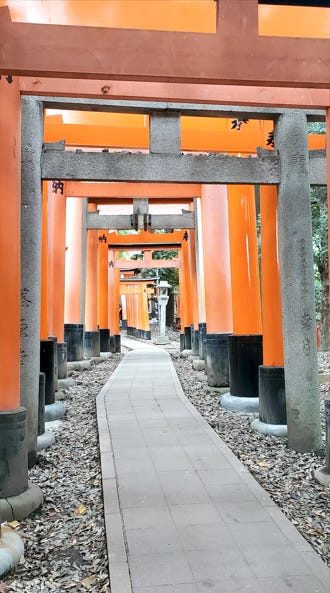
This weekend, Christians celebrate Pentecost which means 50th and commemorates the descent of the Holy Spirit and the birth of the Christian church. At the same time this occurred in Jesus’ time, it was Pentecost for the Jews also called Shavuot. Shavuot is celebrated 50 days after Passover and commemorates the harvest season. Today, I went to Fushimi Inari-taisha, the famous Japanese Shinto shrine that has thousands of torii gates that is dedicated to Inari, the Shinto god of rice and agriculture. Suffice to say, harvesting is on the mind!
Harvesting evokes that cycle we consistently go through in life in all facets - planting, growing and harvesting. This could be business opportunities or relationships. It may relate to our work or our family and friends. We are always either planting or growing or harvesting.
Financial markets also like to think of harvesting. In my derivatives class, we talk about risk-premia harvesting, the idea that there is a premium to taking risk embedded in the markets, and if you know what you are doing, you can harvest it and earn some money. It isn’t easy, as there is no such thing as a free lunch. However, for those with the right training and risk appetite, it can be done successfully. Much like farming or gardening. Casual gardeners may not get much yield. However, with a little training and hard work, the harvest can be bountiful.
As I tour through Japan, I am thinking about harvesting of a different opportunity. Is there a market discount in Japan vs. the rest of the world that perhaps should not exist? I was thinking so before I arrived here. The more time I spend and more discussions I have, the more I think that long risk in Japan could be harvesting an opportunity.
Here me out.
Fundamental
The first and most important step is to assess the fundamentals in Japan. The story that many think of is the 3 decades of economic stagnation the country suffered following its bubble in 1989. As we toured the Imperial Palace this week, I mentioned to my family that at one point at the peak of the bubble, this 1-mile diameter area was once worth more than the entire state of California. It is truly amazing the magnitude of the bubble Japan was in. It was the largest stock market in the world by a long shot. While there was no depression, there was a long, drawn-out stagnation that allowed for the correction. It was exacerbated by a declining population, such that even as per capita GDP began to recover, overall GDP could not grow because of the demographic headwind.
The fortunes of the economy may be changing, however. After importing the inflation no other country wanted post Covid, consumer habits appear to be changing. Wages are slower to catch up but wages and prices are following. As a result, the economy has been surprising on the upside for well over a year at this point.
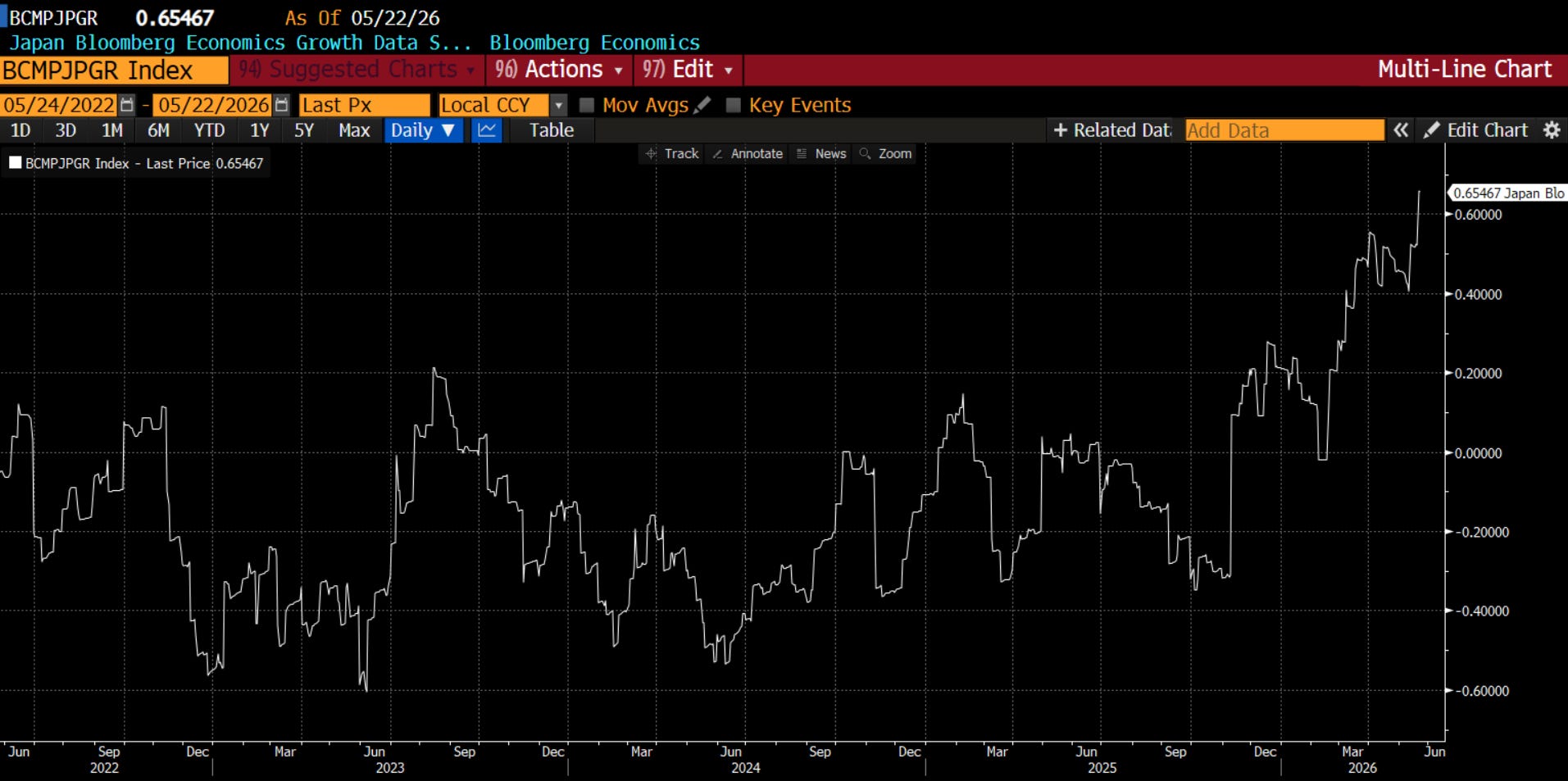
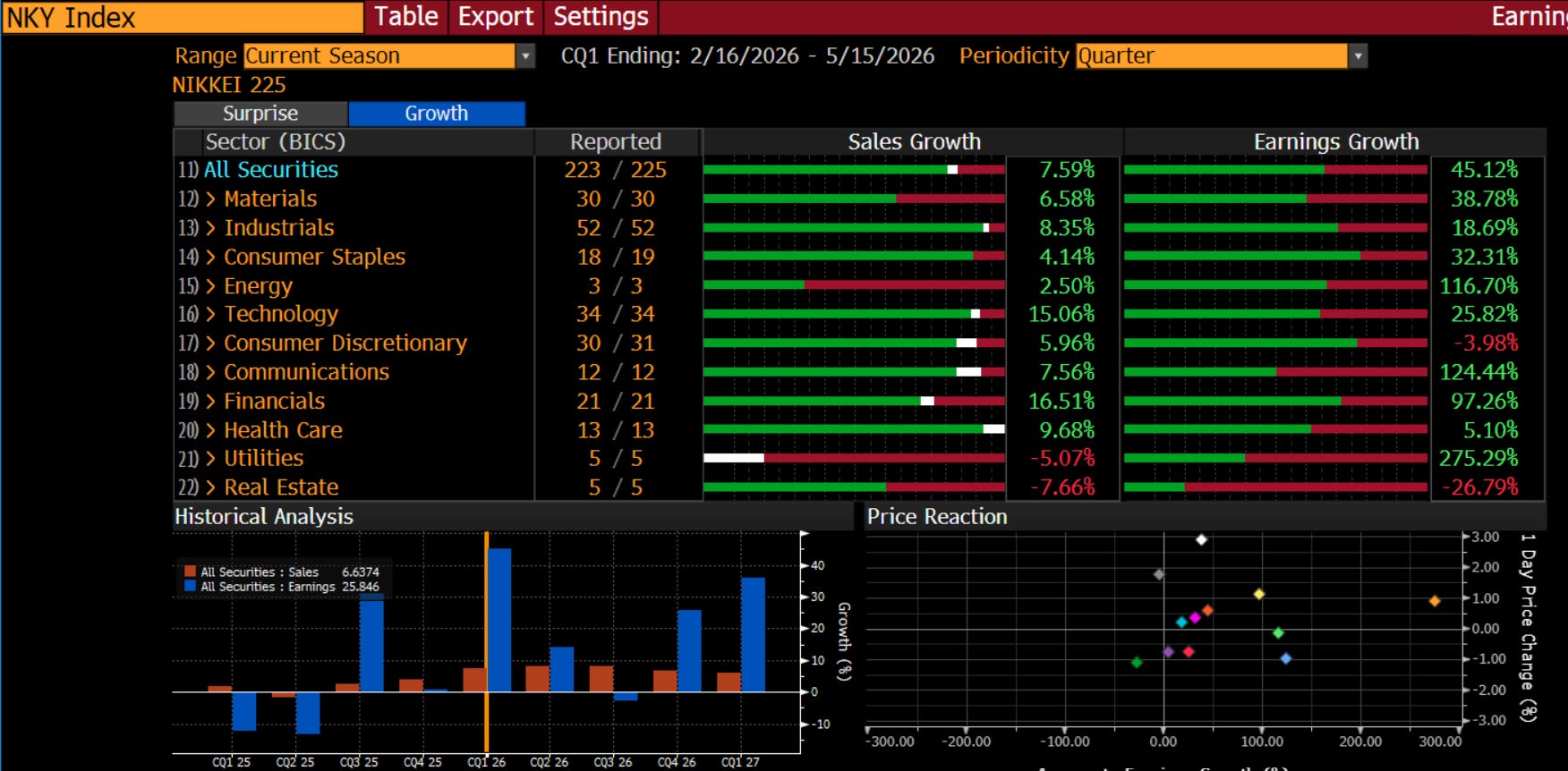
As the economy goes, so go earnings. That was certainly the case this past quarter. With the economy surprising at the fastest pace in a decade, earnings and sales growth were off the charts. With the quarter basically complete, earnings growth is 45% which is truly remarkable. This is a huge positive surprise over expectations. You can see from the lower left this rate of growth far exceeds anything in the last 5 quarters. There were sectors with massive year over year growth. So go earnings, so go stocks.
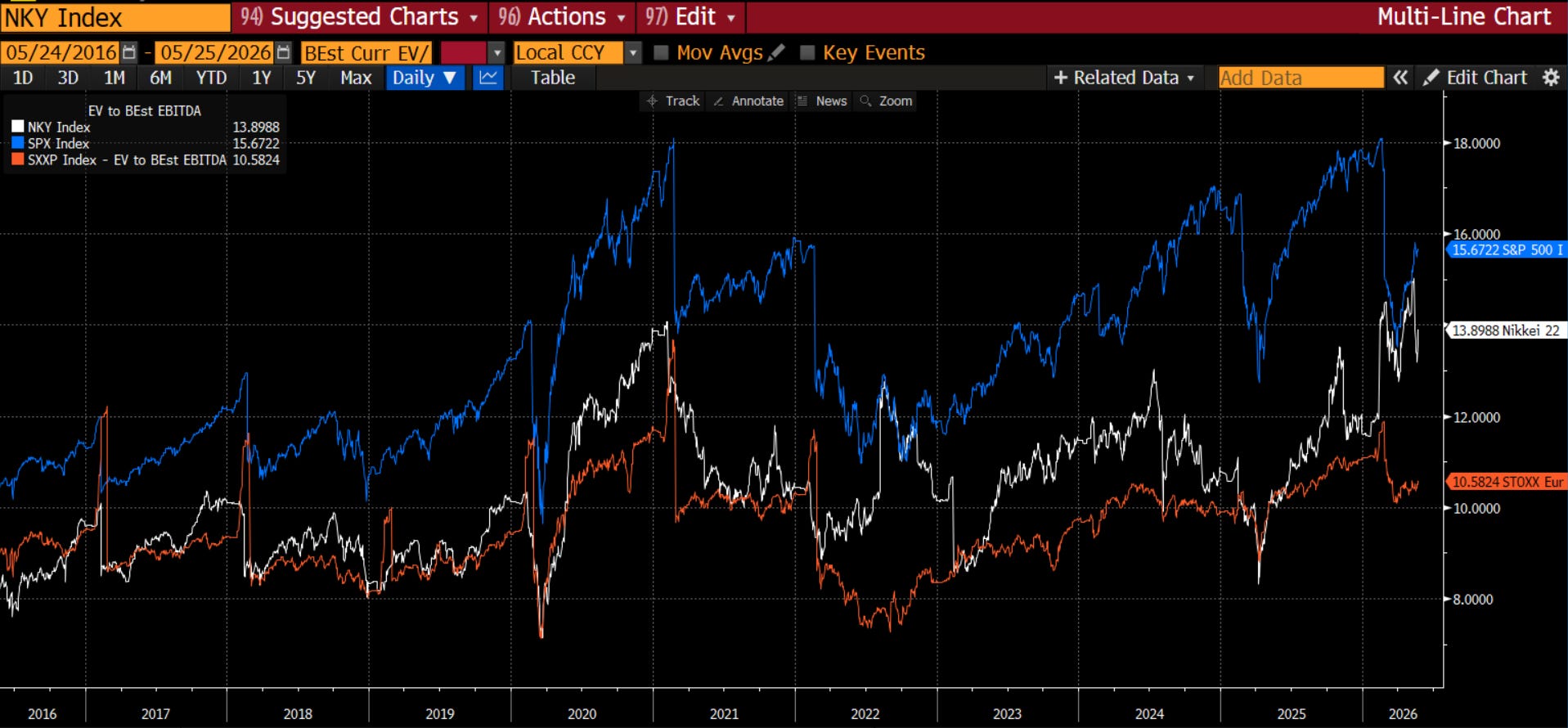
As a result, the Nikkei is starting to close its valuation gap to the US. On an EV/EBITDA basis, the Nikkei now trades at about a 2 turns discount but only last year this was a 4-5 turns discount. You may notice that Europe still trades at quite a discount to both markets right now, but given it has all of the negative catalyst of higher energy prices and none of the positive catalysts of AI, it is a tougher call to make. Yes, the Nikkei has closed a lot of the gap, however, does this just indicate more positive investor sentiment? I think so.
From a fundamental standpoint, Japan looks pretty attractive with a rapidly growing economy, earnings growth off the charts, and a tightening but still discounted valuation.
Behavioral
Of course, the fundamentals are only one leg of the stool. The next leg is what I refer to as the behavioral leg. I measure this by looking at the technical charts and investor positioning. From a weekly chart perspective, we can assess the longer-term trend. It is clear that over the last few years, Japan is in a strong uptrend. Even during pullbacks such as the August 2024 Yen de-risking event of the April 2025 Liberation Day in the US, the TOPIX held the weekly cloud level. After the pullback last spring, it has moved quite a bit higher and recent weakness/consolidation has worked off overbought conditions. The MACD looks like it is set to cross over and move higher again in a sign the bull trend may re-assert itself.
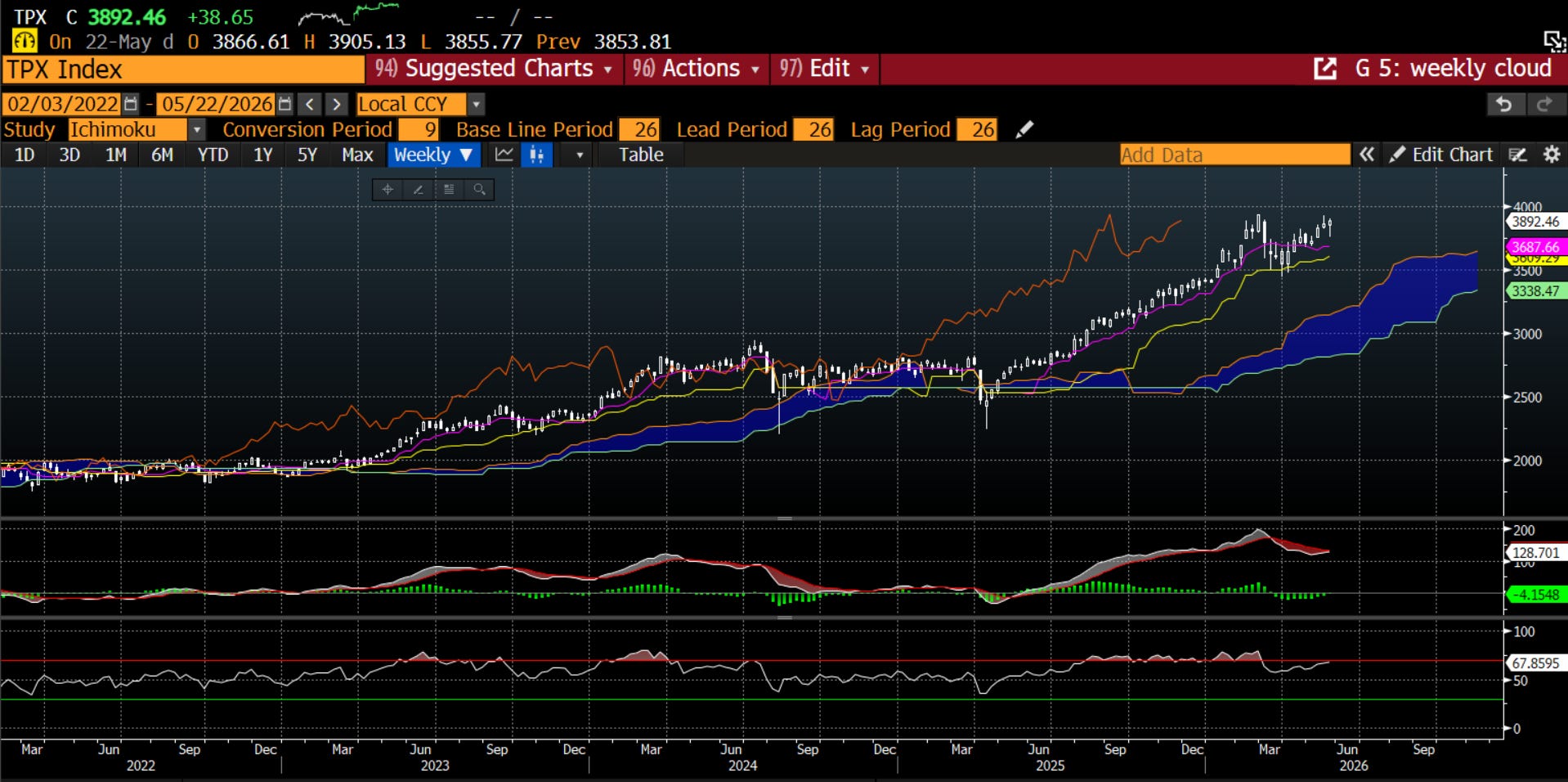
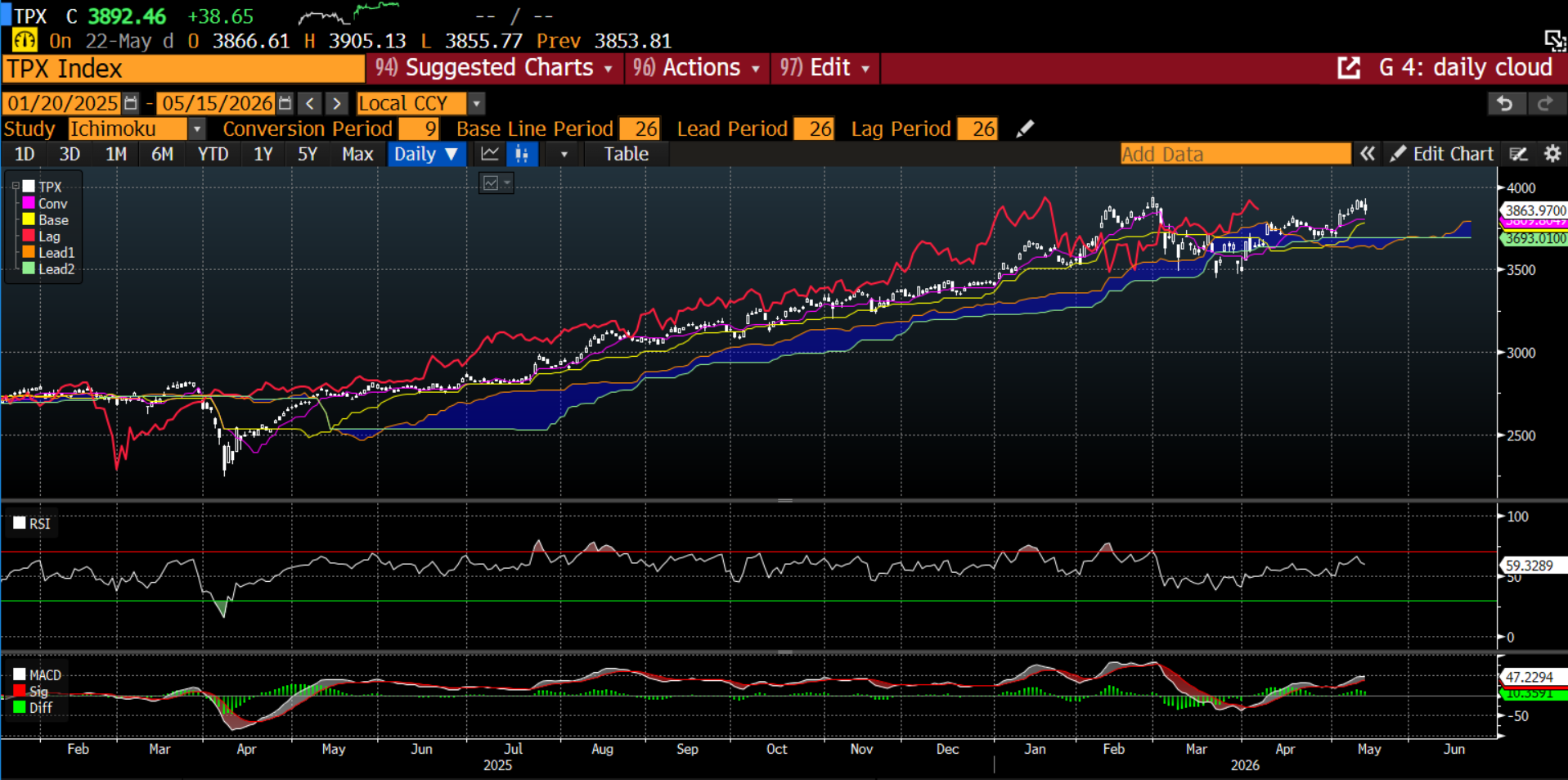
Zooming into the daily charts, the market initially looked like it might break down at the outbreak of the Middle East conflict. However, the lagging span never breached the ichimoku cloud and now price is testing the highs again. Given it is not overbought, a break to new highs would be very bullish indeed.
Are investors positioned for this move? It looks like they are getting that way. This summary from FactSet lays out that stock market turnover is more than double what it was last year. In the past 3 years, volumes have tripled. The old technical axiom is that price follows volume. Volume is exploding, coinciding with the rally. This is a very positive sign.
Nikkei discussed stock market turnover, noting activity in TSE Prime Market surged this month to an average daily total of JPY10.2T ($64B), more than double a year earlier. 14-May alone saw JPY12.376T, a record high including its time as the former TSE First Section era. Over the past three years, Prime Market volumes have grown about three-fold, outpacing a doubling in Nikkei and Topix. Main factor has been foreign investors for which April TSE flow data showed Prime Market gross turnover of JPY254T when combining purchases with sales, also doubling on the year. Individuals‘ activity also expanded more than two-fold over the year to JPY103T, owing to active day trading and NISA inflows. Shares ranked by daily turnover over May-1 to 21 showed AI-tech plays exclusively made up the top ten. Kioxia (285A.JP) has been a highlight this week after market cap has surged to become the fourth-largest stock behind SoftBank (9984.JP). This milestone was achieved Thursday through turnover exceeding a staggering JPY3T, up 135x on the year, and alone accounted for 30% of total Prime Market volumes. Some thoughts that domestic investors are reluctant to buy these names amid overbought concerns, though foreigners attracted by the NAND market tightness story. Next ten names saw some diversification -- MUFJ (8306.JP) was the lone bank, Mitsubishi Heavy (7011.JP) represented the defense theme, Sony (6758.JP) and Nintendo (~7974.JP) for entertainment and Fast Retailing (9983.JP) for consumption/apparel.
The behavioral assessment is equally as positive as the fundamental segment.
Catalyst
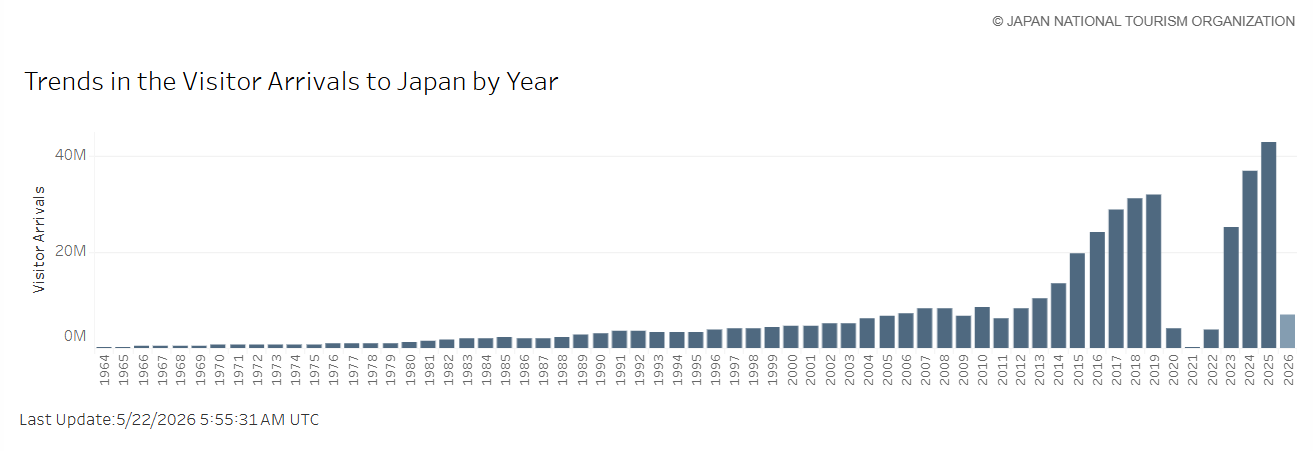
Finally, what are the catalysts? As I travel around Japan this week, it is clear there are tourists here from all over the world - India, China, Australia, US, and just about every country in Europe. Perhaps the weak Yen is attracting them. It is probably something else as well as tourism has been trending higher for the last 12 years. In 2025, tourism was over 40 million visitors. In a country of 127 million, having a third the size come and visit leaves a meaningful impact. There are fleets of Toyota vans to shuttle tourists around. There are certified tour guides showing all the sights. There are police set up to direct traffic. For a country that has historically been quite xenophobic, there is a clear embrace for these tourists as it is bringing economic well-being for quite a few people. Based on my experience this week in conversations with people at the various sites, this year is off to as good a start as 2025, if not better.
Tourism is nice but that can’t be the entire economy. What other trends are there? For so many other markets, there has to be an AI trade. It is starting to sound like there may be one. One thing we have discussed this week is that Japan is excellent at taking a trend or a ‘thing’ from elsewhere in the world and taking it to an entirely different level. This may be food from around the world, or this could be electronics, autos and manufacturing. The latest thing is robotics and automation. We shouldn’t be surprised. With a declining population, Japan will rely on robotics and automation more than other countries. Tokyo 2020 Olympics were meant to be the coming out party for this in Japan, but they were postponed and that never really happened. It looks like investors in AI are starting to recognize the importance of Japanese robotics and automation and how this will play out with the AI trade, in this case the ‘physical AI’ trade. This summary comes from FactSet again:
Japan markets higher: Equities closed sharply higher Friday near intraday highs with Nikkei up 2.68% to a new record and Topix up 1.00%, leaving weekly gains of 3.14% and 0.74% respectively. Main TSE tiers finished with Prime Market up 1.00% on the day, Standard up 1.34% and Growth up 3.66%. Broader growth index logged less than half the increase though still rose sharply and outperformed value. Blue chips were on par with small caps. Intraday Nikkei VIX drifted higher over the session though remained in the low 30s. Sectors were mixed. Strength was led by a sharp rally in nonferrous metals, followed by info & communication, glass & ceramics and electric appliances. Retail, transportation equipment and banks underperformed. Main laggards were insurance, real estate and agriculture. Utilities, construction and pharmas also declined.
Ongoing hopes for a US-Iran peace deal was cited as the main support factor, with latest reports indicating some good progress has been made albeit key sticking points remain on uranium enrichment and control over the Strait of Hormuz. Technically, further easing in crude oil prices and US yields provided substantive grounds for optimism. This in turn further enhanced the resurgence in AI optimism. SoftBank (9984.JP) staged another double-digit rally after hitting limit-up yesterday. Tailwinds from a similar surge in Arm (ARM) came on the heels of yesterday’s news that OpenAI was preparing an IPO. Kawasaki Heavy (7012.JP) rallied on the back of a report that it will partner with Nvidia (NVDA) to integrate AI into robotics. This adds to reports of non-tech companies taking up AI initiatives, offering conduit for AI optimism to broaden into other industries. Indeed, a recent discussion noted value plays are seeing such companies as attractive. So-called ‘physical AI’ has started to gain attention as the most promising channel. Kioxia (285A.JP) saw its market cap grow further after having ascended to the fourth-largest stock behind SoftBank.
Positive fundamentals, positive behaviorals, and catalysts to unlock this opportunity. This sounds like an ideal time for investors to ‘harvest’ this opportunity in Japan.
Final thoughts
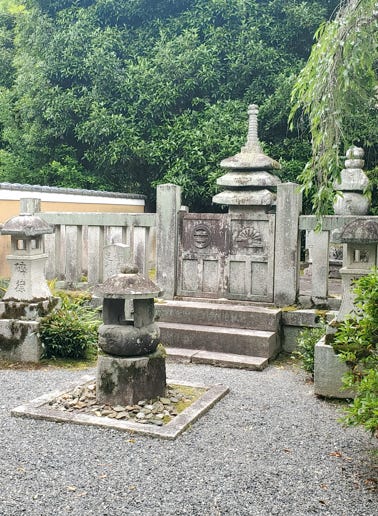
One last place we visited this week was Hokyo-in Temple in Kyoto. The first lesson as we walked around this Zen Buddhist temple was humility. The Buddhist monks maintain the centuries old temple by doing the most basic of tasks - raking leaves, pulling weeds in the garden etc. The idea is that one has to lose their pride and find things bigger than them in order to become a better monk.
The second lesson is forgiveness. This temple contains the graves, side-by-side of military foes Ashikaga Yoshiakira and Kusunoki Masatsura from the 14th century. One of these was a shogun and the other a supporter of the emperor. They were brutal foes that fought to the death. They also followed the same monk. The monk told them they needed to be buried together in a spirit of forgiveness so that this anger would not be passed on to other generations.
Regardless of your faith, regardless of what you do in life, humility and forgiveness are things I think we can all agree on. At least, we all SHOULD agree about them. While this was the lesson at a Zen Buddhist temple, it is certainly one that my Christian faith is always trying to teach as well.
Stay Vigilant, my friends.