
Thought experiment
Looking at three possible analogues to see if any make sense


There is a bit of negativity creeping into the market. Maybe surprising to many is that despite the negative headlines, the market was pretty flat for the week. I know in my own tactical portfolio, no stop-losses were hit on any of the holdings, from small caps to China shares and even to Ethereum.
Bitcoin looks to be in trouble right now, breaking down technically. I feel Ms. Market is going to press and see how diamond Michael Saylor’s hands. MSTR is a weight on Bitcoin right now and I think this bears some watching as it could negatively impact risk sentiment across other products.
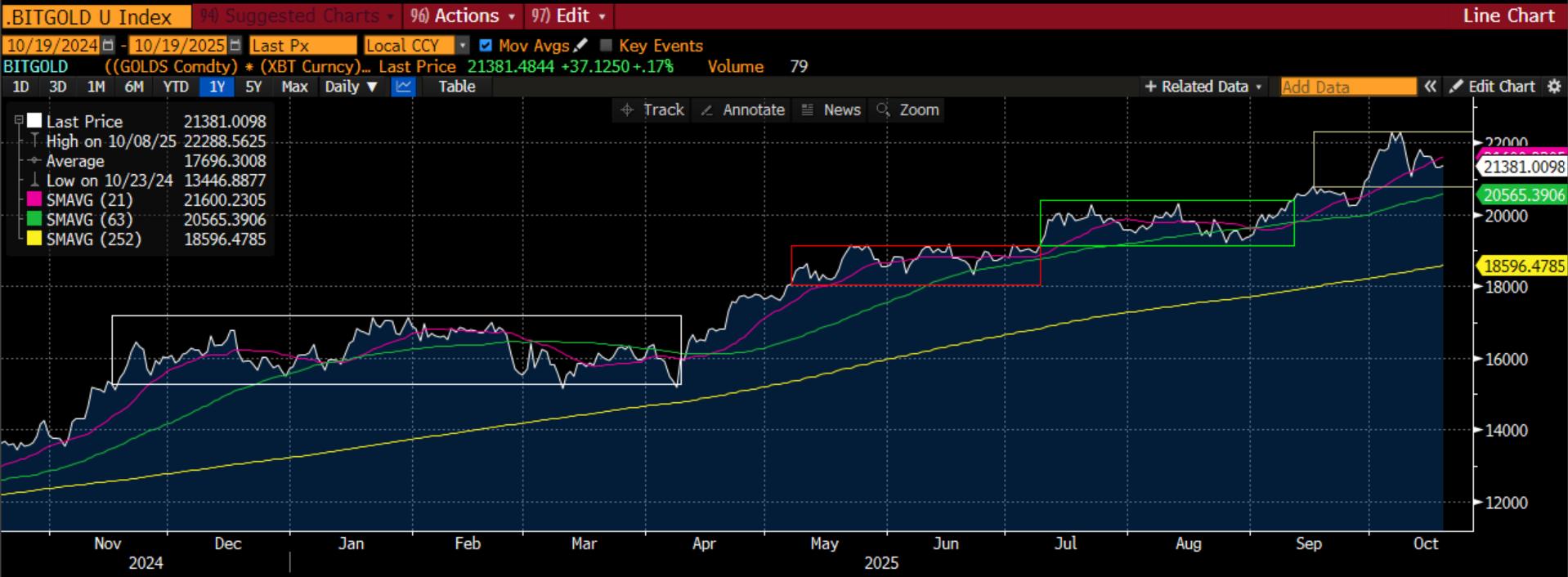
If you hold Bitcoin and gold in a 50-50 ratio, that index is still doing okay, though:
All of that said, the market is trying to determine if there is a brewing credit problem in the US. For over a month, there have been concerns about First Brands and Tricolor. Could this be extrapolated into all of private credit or all bank loans? Jamie Dimon, the CEO of JP Morgan, didn’t help when he referenced that there is never just one cockroach in his conversation with analysts after earnings this week. He was quick to say they don’t have a problem, and likely they don’t. JP Morgan is the gold standard of banks and was a winner during the Great Financial Crisis. However, this comment alone put even more emphasis on other bank earnings and investors did not hear great news. Zion Bancorp and Western Alliance Bank had to take write-downs on different events. This hit all bank stocks and led to investor concern over the impact on tightening credit in the economy.
“In times of loose credit, you are going to have more instances of fraud,” said Mike Mayo, banking analyst at Wells Fargo. “Right now, credit in general is fine, but there’s a heightened need to watch the recent issues.”
Mike Mayo is a well-followed bank analyst and is not one to be overly optimistic in my experience with him. For the time being, this bears more watching and may be a weight on the market. I still think earnings are going to be solid and will potentially be the catalyst that lifts all stocks in a strong end-of-year rally. That said, there will be more concern as we look into 2026.
I covered credit problems and the outlook for 2026 in my discussion with Keith McCullough from Hedgeye at their investing summit this week:

There were a number of great guests so I encourage you to have a listen to the replay:
As I prepared, I went through a few analogues of the current market environment. I have heard references to this period being like the Tech Bubble in the late 90s. I have also heard references to the Roaring 20’s of 100 years ago and why what we are seeing is the same. Personally, there is a different analogue that makes sense to me. I will present each one, and while they all end badly, this is not a prediction of a crash. All business cycles end at some point, so for me the key to the analogue is to have an idea of how it might play out and the signs we should be watching for to know if we are just in the middle or near the end of the cycle. Much like any other model, the quote “All models are bad, some are useful” holds true. For those that did not live through those periods, understanding the environment can help prevent future mistakes. I think it is a useful Thought Experiment.
Roaring 20’s
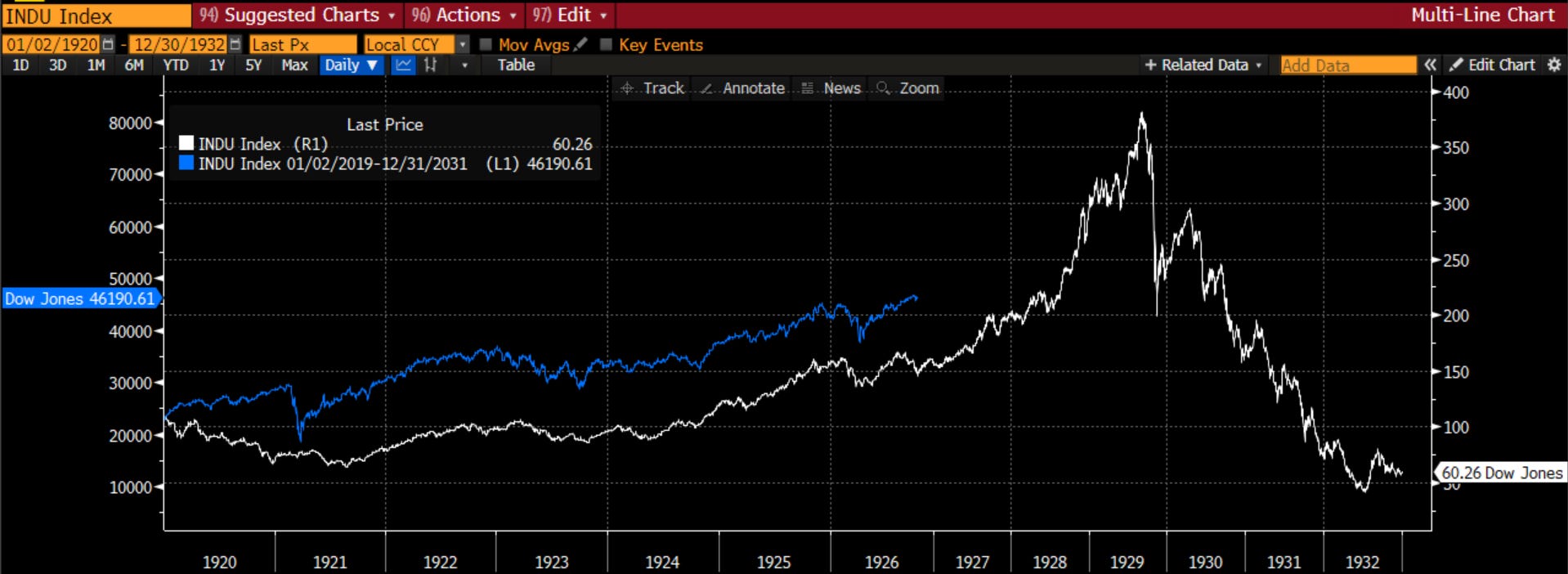
The chart above compares the Dow Jones Index from 1920-1931 to the current Dow Jones Index starting in 2019. This is the comparison that people try to make. I use Dow Jones because we didn’t have the S&P 500 or Nasdaq 100 back in the 1920’s. As you can see, it looks like a compelling analogue as the price action looks pretty similar. If you simply followed this, you would suggest there is still 3 more years of strong returns, but a crash is inevitable so you better watch for signs for that crash and get out even after it happens because the 1929 crash was just the start.
What are the similarities in the current period vs. the Roaring 20’s?
Geopolitics
100 years ago the US was coming out of World War 1. There was a global pandemic as well which we now call the Spanish Flu even though it started in Kansas. I guess Kansas flu didn’t have a good ring to it. Because of the lost sons, and the fear that globalization only brought bad things like these viruses to our shores, there was a growing demand to pull back from the world stage. US retreated from European politics and began to focus on domestic prosperity. Sound familiar?
US Monetary and Fiscal policy
This period was defined by tightening credit. The central bank raised rates in an attempt to curb stock speculation which was becoming a bit of a past time even for retail traders. While one can argue there is some speculation in the market with meme stocks, alt coins and 0 DTE options, I think we can agree that the central bank has not been tightening credit. In addition, the 1920’s were a time when the government had very little debt, again, very unlike the current situation.
Investment Sentiment
Again, it was a bubble. There was widespread use of margin debt by retail investors who held a belief in a “new era” of wealth. When you watch “It’s a Wonderful Life” this Christmas, recall the conversation George Bailey has with his boyhood friend who is making a killing on Wall Street. The movie captures that sentiment and the resulting crash. We can argue that the FOMO/YOLO/TINA mindset is similar to that. While there may not be the use of margin debt, the leverage embedded in 0 DTE options, 2 and 3x levered ETFs, and in the perpetual futures or perps in the crypto market all bear similar resemblance.
Concentration of Ideas
Right now we speak of the concentration of ideas and themes in AI and the Mag7 and think there is nothing like that in history. While the magnitude is high, the concentration of thought is not dissimilar. In the Roaring 20’s it was all about industrial giants, railroads and utilities (think of the game Monopoly) because those companies led by the “Titans of Industry” like Rockefeller and Vanderbilt were producing the vast concentration of wealth. The infrastructure built by many of these companies lasts to this day.
Inflation/Growth
The period 100 years ago was marked by high growth and low or stable prices. The industrialization of the economy led to massive productivity gains that drove both the top line but also the bottom line for the economy and the stocks themselves. I think on this front we currently have the biggest difference. While there is the promise that AI will lead to high productivity driving high growth and lower prices, and there is no shortage of people predicting that, we are simply not seeing that in the data right now. Productivity data has not particularly improved, growth is trudging along, and price levels appear to be turning higher, not lower.
Crash Catalyst
The catalyst for The Crash of 1929 was Fed rate hikes and a slowdown in manufacturing that triggered a panic selling spree and a cycle of margin calls. It is safe to say we aren’t there yet because the Fed is going in the opposite direction.
Tech Bubble
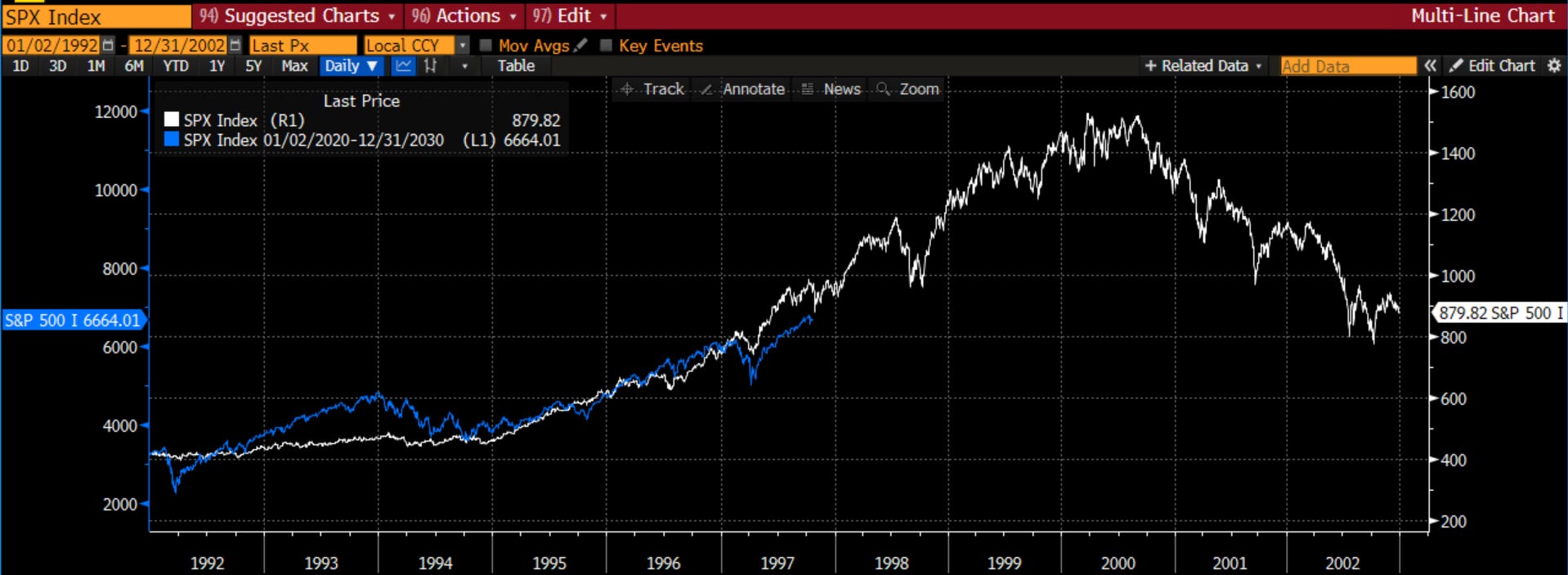
The most obvious analogue that people refer to is the Tech Bubble. The capex investment in AI has many thinking about the over-investment in fiber optics. In fact, many say it is worse, because at least with fiber, we eventually used it all. With AI, in 20 years, the chips will be in a landfill because we will have faster one. However, the companies spending on AI are doing so out of earnings and cash flow and not with speculative investment dollars as was the case in the dot.com era. Let’s look at the periods using a similar framework.
Geopolitics
The analogy breaks down pretty quickly just a this first point. The 90s were characterized by globalization and the peace dividend from the end of the Cold War in 1989. Companies were moving people all over the world to take advantage of this new world order. I know this because right out of college, I was sent to Japan, Switzerland, Singapore and Hong Kong to live. It wasn’t just financial services either. Every industry was trying to lower costs by sourcing labor and materials anywhere in the world that was cheapest. Thank you, Jack Welch. I think it is safe to say that given move to make supply chains redundant and bring manufacturing back onshore/near shore/friend shore, combined with more geopolitical tensions than we have seen this century, the backdrop is quite different.
US Monetary and Fiscal policy
Another reason people like to compare is that the mid90s was a period where the yield curve inverted yet we only had a mid-cycle slowdown and no recession, just like this current period. The Fed was mildly tightening rates, but when there was any trouble anywhere in the world e.g. Asian Financial Crisis or LTCM, Alan Greenspan was quick to lower. In fact, this is where the idea of the Fed put came in, which still exists today. However, the fiscal situation was quite different. Driven by enormous profitability and wealth, the US actually got to a fiscal surplus in 2000, thanks to Bill Clinton and Newt Gingrich. People on different sides of the aisle working together to improve the fiscal sustainability? Umm, we don’t have that now.
Investment Sentiment
The late 90s were all about ‘Irrational exuberance’. We developed new methods to value companies, with a focus on “eyeballs” and “potential”. We used this new approach to justify investing in the hot ideas, basically anything with a dot.com. Companies with no revenue traded at high multiples. Companies that today would be considered ‘pre-seed’ were going public. Right now, there is certainly some of that going on. I had a discussion this week with my students about the stocks in quantum computing. Our school is heavily focused on this area, so we are rooting for success of quantum. That said, realistically, most of these ideas are 10 years away from commercialization. So, things do seem speculative. That said, the real driver of markets is AI and the capex into data centers and compute. This is being driven by companies with earnings, even if there is a little bit of self-dealing going on.
Concentration of Ideas
The Tech Bubble was driven by The Four Horsemen - Cisco, Intel, Microsoft, Dell. Outside of these names, there was a huge bubble in unprofitable tech start-ups. Right now, the market is driven by the Mag7 and we are not seeing the same magnitude of bubble in other parts of the market just yet. Certainly nothing on the scale of the late 90s.
Inflation/Growth
Another big difference versus the current period in my estimation. This was once again a period of very strong growth and low inflation. The peace dividend from the end of the Cold War, leading to the ability for companies to lower costs by sourcing labor & materials in countries far afield, led to growth with no inflation at all. Now, we do see some growth, but it comes at a cost of higher prices. The disruption of global supply chains and the radical change in immigration ideas is leading to higher costs for companies and not lower costs. The question only becomes ‘can they pass them on?’
Crash Catalyst
All about earnings. Big technology companies started missing earnings estimates, shattering the perpetual growth narrative for the entire sector. This gave rise to one of my favorite charts which I still use in class to this day:
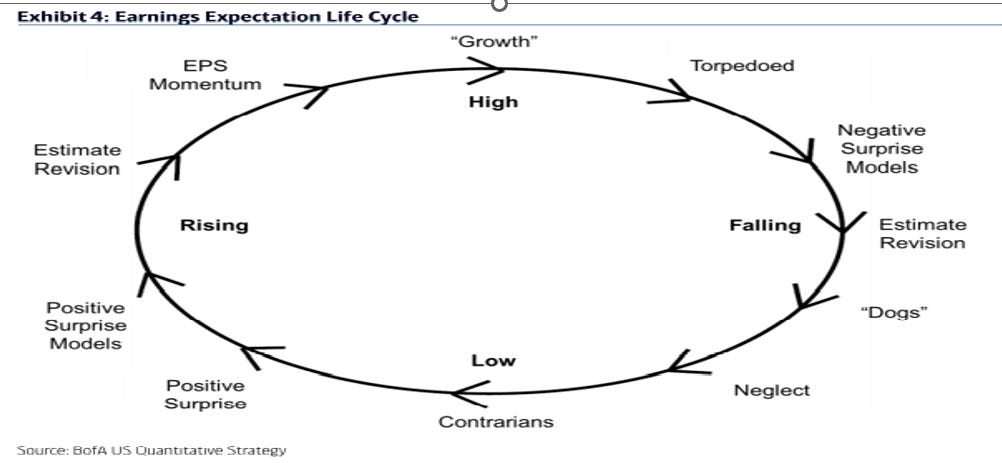
Right now, the Mag7 companies that are doing the heavy investing still have strong earnings. Whether or not these come from AI or not is the question. This is why I think it is so critical to watch earnings season closely.
Nifty 50 Era
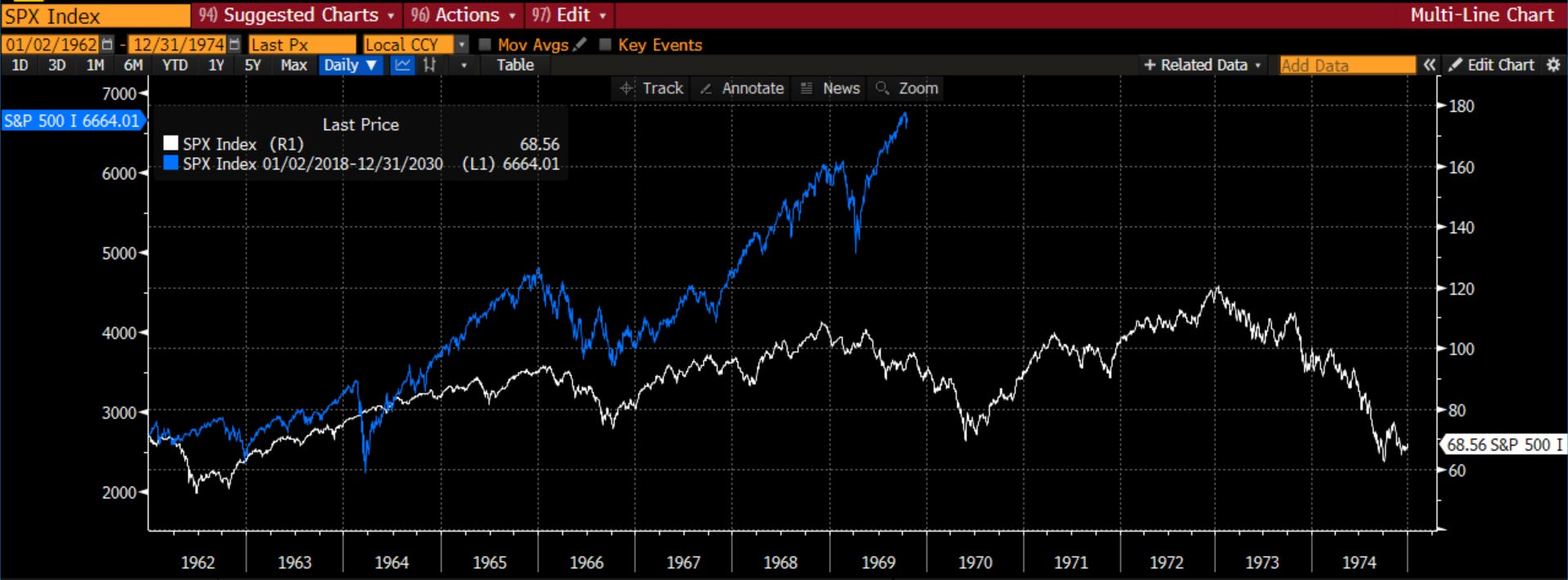
The analogue of this chart bears the least resemblance, at least in magnitude. I think that is why many people don’t consider the two periods to be similar. After all, to get a lot of likes/follows on X, you need to have a good picture to share when you call for a crash. However, when we go through each of the categories, I think there are more things that are similar in the 1960s/70s Nifty 50 Era than there are differences.
Geopolitics
The US was not only deeply involved in the Cold War, but this led it into many proxy wars around the world, not the least of which was the Viet Nam War. The conflict the US has with the Russia/China/Iran axis in various parts of the world has been characterized as Cold War II by no less than Nial Ferguson, the well-regarded historian. This War led to deep social divisions in the country where the two parties and their followers were deeply divided. This led ultimately to political assassinations of key figures, unfortunately something we have started to see picking up.
US Monetary and Fiscal policy
Guns and Butter. That was the prescription from LBJ and the Great Society where money was spent on the domestic agenda (butter) and in fighting wars abroad (guns). While we started the year with DOGE in an attempt reign in fiscal excesses, what we are seeing not just this year but going back quite some time is that neither political party has an appetite to cut spending which is why we get new spending on new ideas in each term. While not named guns and butter, there is clearly money being spent on everything domestic and abroad. In the 1960s, the central bank head was chided into keeping rates low so the government could afford this spending. That is exactly what we are seeing now as well.
Investment Sentiment
This era was all about “One-Decision” Stocks. Belief that you could buy and never sell the fifty best blue-chip, large-cap growth companies at any price. You would never get fired for buying IBM. Right now, that is exactly what we see with the Mag7 names. Heck, growth stocks in general, large cap vs. small cap, US vs. international. If you don’t want to get fired, you better own NVDA.
Concentration of Ideas
Coca-Cola, IBM, Xerox, Kodak all traded at P/E, a large premium to the market. The former was the celebration of Americana around the world. The latter two were about the digitization of the economy into a new world of compute. Sure, we only think of Xerox as the copier company or Kodak about film, but the R&D done at these companies led to some amazing achievements. The companies just didn’t capitalize. This is what we are seeing now with Nvidia, Microsoft, Google et al. There are a few names that have all of the profitability, much like in the 1960s.
Inflation/Growth
Because the Fed was essentially monetizing the debt of the US government, inflation was never able to come under control, even though it appeared to for brief periods. Inflation showed a period of higher lows and finally got to a blow-off top in the 1970s, leading to dramatically different Fed policy under Volcker, something Arthur Burns before him had no ‘will’ to do. I fear this is exactly what we see now. The competition to be the most dovish central banker in an attempt to become the next Chair is leading to inflation that will continue to grind higher. Politicians see inflation as the way out since they can’t default, won’t restructure and realistically can’t grow out given the demographics of the country. Thus, monetizing the debt is the easiest. Up until now, no Fed Chair wanted to be the next Arthur Burns. Now it seems they are lining up to do so. This inflation in the 1960s led to stagflation because prices were too high to see any consumption, thus the government needed to do more and more. You know where I stand on stagflation, but just ask those around you if prices are too high to lead to much consumption.
Crash Catalyst
The oil embargo and the persistence of inflation shattered the “growth-at-any-price” narrative for the Nifty Fifty. Perhaps now it will be the rare earths embargo which freaked out the market the other day. I certainly fear the persistence of inflation as we turn the calendar and look into 2026. Growth at any price is still the call when we take into account the valuations of Mag7. Will the macro shatter this narrative?
________________________________________________________________
As a Thought Experiment, I present to you three different analogues. Three distinct periods in US financial history that bear some similarities to the current situation. In the over-used quote, history doesn’t repeat but it rhymes. I don’t think this period is exactly like any of those. I do think it is more like one than the other. I do think that understanding how each developed is a worthwhile exercise and can make you a better investor. Even in the worst of those, there is no need to call for an imminent crash. That is not what I am doing. In fact, in most, it would argue for 2-3 more years similar to what we just saw. However, to have a view on what should, what is and what will happen, we need to learn from history lest we make the same mistakes. Let me know in the comments if you would vote on any of these, or if there is a different period that is helping your investing.
Stay Vigilant

Halving narrative is always a helpful time period to consider. Sell today buy back next May could be fruitful for btc
The cockroach comment, wow. What if it's a whole hidden nest, huh?